By William Varner, Ph.D.
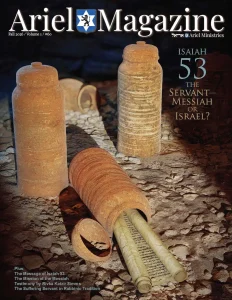
This article originally appeared in Ariel Magazine, Fall 2026, Vol. 1, No. 60. Readers who wish to view the article in its original magazine format may access the complete issue here.
In Messianic discussions, it is well known that the “Jewish view” of Isaiah’s Servant has adopted the position of the great Rashi (ca. A.D. 1100)—namely, that the Servant represents suffering Israel rather than the Messiah. What is often overlooked, however, is that the majority rabbinic opinion prior to Rashi identified the Servant as the promised Messiah. This article presents some of that evidence.
In the Second Century
The Targum of Jonathan ben Uzziel (second century), reprinted by Oxford University Press at the Clarendon Press in 1953 under the title The Targum of Isaiah, edited and translated by J. F. Stenning, renders Isaiah 52:13 as follows: “Behold, My Servant, the Messiah, shall prosper; He shall be exalted, and increase, and be very strong.”
In the Sixth Century
The Babylonian Talmud, codified in the sixth century, states the following concerning Isaiah 53: “The Messiah—what is his name? … And the Rabbis said: ‘The leprous one of the house of Rabbi’ is his name, for it is written, ‘Surely He has borne our sicknesses and carried our pains; yet we esteemed Him stricken, smitten by God, and afflicted'” (Sanhedrin 98b:14).
In the Sixteenth Century
Rabbi Mosheh el Sheikh, commonly known as Alshech, the chief rabbi of Safed in the sixteenth century, wrote the following concerning Isaiah 53 in his Minhat Qe’tannah, a commentary on the Former Prophets: “Our Rabbis with one voice accept and affirm the opinion that the prophet is speaking of the King Messiah, and we shall ourselves also adhere to the same view.”
The Evidence Collected by Driver and Neubauer
Researchers are indebted to a valuable but overlooked volume by two nineteenth-century Oxford scholars, one of whom was Jewish, for collecting evidence spanning more than a millennium. The work, The Suffering Servant of Isaiah According to Jewish Tradition by S. R. Driver and Adolf Neubauer, was originally published in 1877 and reprinted by Wipf and Stock in 2000. The following three rabbinic sources are cited from this work together with the appropriate page references.
Rabbi Joseph ben Kaspi (1280-1340 A.D.) warned the rabbis that “those who expounded this section of the Messiah give occasion to the heretics (Christians) to interpret it of Jesus.” In response to this, Rabbi Saadia ibn Danan observed: “May God forgive him for not having spoken the truth” (Driver & Neubauer, 203).
Rabbi Moshe Kohen ibn Crispin, of Cordova and afterwards Toledo (fourteenth century) in Spain, says: “Those who for controversial reasons apply the prophecy of the suffering servant to Israel find it impossible to understand the true meaning of this prophecy, having forsaken the knowledge of our teachers, and inclined after the stubbornness of their own opinions. Their misinterpretation distorts the passage from its natural meaning, for it was given of God as a description of the Messiah, whereby, when any should claim to be the Messiah, to judge by the resemblance or non-resemblance to it whether he were the Messiah or no.” Crispin also said: “I am pleased to interpret the passage in accordance with the teaching of our Rabbis of the King Messiah… and adhere to the literal sense. Thus shall I be free from forced and far-fetched interpretations of which others are guilty.” He also said: “This prophecy was delivered by Isaiah at the divine command for the purpose of making known to us something about the nature of the future Messiah, who is to come and deliver Israel… in order that if any should arise claiming to be himself the Messiah, we may reflect and look to see whether we can observe in him any resemblance to the traits described here: if there is a resemblance, then we may believe that he is the Messiah our Righteousness; but if not, we cannot do so” (Driver & Neubauer, 114, 199).
Rabbi Naphtali Ben Asher Altschuler (early seventeenth century) states: “I am surprised that Rashi and David Kimchi have not, with the Targum, also applied them (vss. 52:13–53:12) to the Messiah” (Driver & Neubauer, 319).
In the Nineteenth Century
The nineteenth-century Jewish scholar David Levy cited the following passage from a Musaf service prayer for the Day of Atonement:
“Messiah our Righteousness has departed from us. We shudder, for there is none to justify us. He bears our load of transgression and the burden of our guilt and is verily pierced for our rebellions. He carries our guilt on His shoulder to effect forgiveness of our sins. He bled for our salvation. O Eternal One, the time has come that Thou shouldest create Him anew! O bring Him up from the terrestrial sphere. Raise Him up from the land of Seir, to assemble us on Mt. Lebanon a second time, by the power of Yinnon!”
This citation appears in David Levy, Prayers for the Day of Atonement, 2nd ed. (London, 1807), III:37.
Kabbalistic Observation
Gershom Scholem, the renowned Jewish scholar of Kabbalah, explained in Sabbatai Sevi (pp. 53-54) why Rashi and later rabbis moved away from the Messianic interpretation of the Servant toward identifying the Servant with Israel: “In the Tannaitic period the ‘suffering servant’ passages had been interpreted as referring to the Messiah, but later Haggadists as well as the medieval commentators preferred different interpretations. In order to undermine Christian exegesis, he was interpreted as a figure of Moses, or of Israel, or of the pious in general” (emphasis added).
Contemporary Scholarship
One of the most surprising contemporary sources on this subject is Daniel Boyarin, the renowned Talmudic scholar at the University of California, Berkeley. In his volume The Jewish Gospels, Boyarin argues convincingly that Second Temple Judaism did affirm both a suffering Messiah and a divine Messiah. Evidence for this view appears not only in the sources mentioned above but also in numerous Jewish texts, including those discovered at Qumran.
Conclusion
These quotations represent only a small sampling of the hundreds of sources cited by the above Jewish scholars, all of which provide irrefutable evidence that the pre-Rashi rabbinic view of Isaiah’s Suffering Servant identified Him as the promised Messiah. The quotations fall short of concluding that the Servant was divine and will rise from the dead, but they conclusively show that the “Israel” interpretation arose much later.
After surviving the Holocaust, Rabbi Sam Stern met several young believers in New York who shared with him the good news of the Messiah. He remained unconvinced until a friend asked him to read the words of Isaiah 53, typed in English on a sheet of paper without chapter or verse references. When asked what he thought he was reading, Sam replied that it must have been written by a Christian about the death of Jesus. When he was told that the passage had actually been written by the prophet Isaiah, he was compelled to examine the text in his Hebrew Bible and discovered that it was identical to the English passage he had read. Sam later pointed to that experience as the moment he began to seriously consider the message that Jesus was the Messiah. He faithfully proclaimed the good news concerning the Messiah in Brooklyn until his death in the early 1980s.
Like Sam Stern, thousands of Jewish people have identified Isaiah 53 as the passage that more than any other opened their hearts to the message that Jesus is the promised Messiah.
This article originally appeared in Ariel Magazine, Fall 2026, Vol. 1, No. 60. Readers who wish to view the article in its original magazine format may access the complete issue here.
Copyright © 2026 Ariel Ministries. Originally published in Ariel Magazine, Fall 2026, Vol. 1, No. 60. This article is republished on the Ariel Ministries website with permission. All rights reserved. No part of this publication may be reproduced, distributed, or transmitted in any form or by any means without prior written permission from Ariel Ministries. Permission requests may be directed to corporateoffice@ariel.org.