By Arnold G. Fruchtenbaum, Th.M., Ph.D.
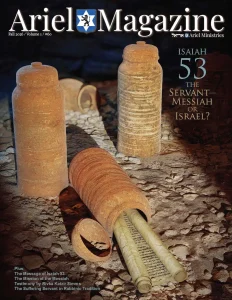
This article originally appeared in Ariel Magazine, Fall 2026, Vol. 1, No. 60. Readers who wish to view the article in its original magazine format may access the complete issue here.
Isaiah 52:13–53:12 stands as the clearest presentation in the Hebrew Scriptures of the substitutionary and atoning death of the Servant of YHWH. The passage foretells not only the Servant’s suffering and execution but also His resurrection and exaltation. Before addressing these truths further, it is helpful for the reader to consider the prophetic implications of a specific section of this passage: verses 1-9.
The Prophetic Context of Isaiah 53:1-9
In their prophetic context, these verses record the future national confession of Israel in the closing days of the tribulation (Dan. 12:6-7, 11-12; Hos. 6:2). They summarize Israel’s former response to the first coming of the Messiah, Yeshua of Nazareth, and confess that this response had been a mistake.
This confession precedes the second coming of the Messiah. In Matthew 23:39, Yeshua declared that His return is contingent upon Israel’s acknowledgment: “Blessed is he that comes in the name of the Lord.”
This condition was already stated in Hosea 5:15, where God proclaimed that He would not return to His place “till they acknowledge their offense, and seek my face.” According to Zechariah 12:10, this condition will be fulfilled when Israel looks upon Him whom they have pierced and mourns. In that day, the Jewish community will declare in one voice: “Blessed is Yeshua the Messiah who came to us in the name of YHWH.” From Micah 2:12-13, it is evident that at that time the remnant of Israel will be gathered in Bozrah in the land of Edom.
The Scene at Bozrah
Let us, for a moment, picture the scene. Thousands upon thousands of Jewish people are huddled together in Bozrah (Isa. 34:6; 63:1-6; Joel 3:12-14; Mic. 2:12; Zech. 14:2), surrounded by the high red cliffs of Edom and facing a massive army gathered roughly 130 miles to the north in Jerusalem, preparing to strike and annihilate. In that setting, the Jewish people will finally cry out to God and confess the words of Isaiah 53:1-9:
“Who has believed our message, and to whom has the arm of the Lord been revealed? He grew up before Him like a tender shoot, and like a root out of parched ground. He has no stately form or majesty that we should look upon Him, nor an appearance that would attract us to Him. He was despised and forsaken of men, a man of sorrows and acquainted with grief. Like one from whom men hide their face, He was despised, and we did not esteem Him.
Surely our griefs He Himself bore, and our sorrows He carried. Yet we ourselves esteemed Him stricken, smitten of God, and afflicted. But He was pierced through for our transgressions, He was crushed for our iniquities. The chastening for our well-being fell upon Him, and by His scourging we are healed. All of us like sheep have gone astray, each of us has turned to his own way, but the Lord has caused the iniquity of us all to fall on Him.
He was oppressed and He was afflicted, yet He did not open His mouth. Like a lamb that is led to slaughter, and like a sheep that is silent before its shearers, so He did not open His mouth. By oppression and judgment He was taken away, and as for His generation, who considered that He was cut off out of the land of the living for the transgression of my people, to whom the stroke was due? His grave was assigned with wicked men, yet He was with a rich man in His death, because He had done no violence, nor was there any deceit in His mouth.” (Isa. 53:1-9, NASB 1995, emphasis added)
Following this confession by Israel, the Messiah returns first to Bozrah in the land of Edom, as described vividly in Isaiah 63:1a: “Who is this who comes from Edom, with dyed garments from Bozrah?” From there, He delivers the remnant and goes forth to wage war against the nations.
The nations themselves will have gathered in Jerusalem (Zech. 14:2), brought down for judgment in the Valley of Jehoshaphat (Joel 3:2, 12). The battle they intended to carry out against Israel is ultimately turned against them (Zech. 14:3-4). Those who wanted to make a bloodbath of slain Jews will themselves be slaughtered, and their blood will reach all the way up to the horses’ bridles (Rev. 14:19-20; cf. Isa. 34:5-8).
This sequence culminates in the complete defeat of Israel’s enemies and ultimately in the defeat of Satan himself, as the armies are destroyed at the return of the Messiah (Rev. 19:11-21) and Satan is bound (Rev. 20:1-3).
With this picture in mind, consider the interpretive debate surrounding Isaiah 52:13–53:12. At its core lies a basic question: Does this passage indeed describe an individual—namely, the Messiah—or does it rather refer to the nation of Israel?
The Traditional Rabbinic Interpretation
A careful reading of the text shows that the Servant must be an individual. The consistent contrast between plural pronouns such as “we,” “our,” and “us” and singular pronouns such as “he,” “him,” and “his” distinguishes the Servant from Israel. Isaiah, speaking as a Jew to a Jewish audience, identifies himself with the plural “we,” referring to Israel, while the singular pronouns point to someone else, distinct from the nation, who bears their sin. Likewise, Isaiah 53:8 states that the Servant is cut off “for the transgression of my people.” Since “my people” refers to Isaiah’s people (Israel), the Servant cannot be Israel.
Furthermore, the experiences attributed to the Servant—trial, imprisonment, death, burial, and resurrection—can apply only to an individual, not to a nation. The Servant is portrayed as a voluntary, silent sufferer, innocent and sinless, whose suffering is vicarious. Israel’s sufferings, by contrast, are consistently presented in the Hebrew Scriptures as the consequence of her own sins, not as substitutionary atonement for others.
The Servant’s suffering results in justification (Isa. 53:10-11), a result never attributed to Israel’s historical suffering. Finally, the Servant dies and is then described as living again, indicating resurrection, whereas Israel as a nation has never ceased to exist.
These observations align with the earliest rabbinic interpretations.[1] Prior to the Middle Ages, the dominant Jewish understanding identified the Servant as the Messiah, often specifically as Messiah ben Joseph—Messiah, the son of Joseph—to be distinguished from Messiah ben David, the victorious, reigning Messiah.[2] This interpretation is reflected in ancient sources such as Targum Jonathan (ca. 150 B.C.–A.D. 350), which explicitly renders the introduction to the passage, verse 52:13, in Messianic terms: “Behold, my servant the Messiah shall prosper. He shall be exalted and extolled, and He shall be very strong.”[3] Thus, the Messianic reading is not a later innovation but the traditional Jewish view.
A Shift of Interpretation
Not only did the ancient and early rabbinic sources identify the Servant as the Messiah, but some of them also emphasized His vicarious suffering.[4] This Messianic framework continued into the early medieval period, as reflected in the Zohar[5] and the writings of Yepheth Ben ‘Ali,[6] Maimonides,[7] and Nachmanides.[8]
Around the eleventh century, a new interpretation was introduced that identified the Servant as representing the whole house of Israel and only rarely the believing element within Israel. This view was set forth by the most influential Jewish scholar of the Middle Ages: Rabbi Shlomo ben Yitzchak, best known by the acronym “Rashi.” This Torah and Talmud commentator lived from 1040 to 1105.
While Rashi’s teaching influenced Ibn Ezra (1089–1197) and David Kimchi (1160–1235), most rabbis rejected this interpretation[9] until the 1800s, when European Jews began leaving the ghettos and encountered evangelical believers who used Isaiah 52:13–53:12 as a witnessing passage. At that time, the majority of rabbis adopted the national view. Today, it is difficult to find a rabbi who teaches the Messianic interpretation, though some contemporary Jewish scholars, such as Rabbi Adin Steinsaltz (1937–2020), acknowledge at least an element of ambiguity in the passage.[10]
Who Was Rashi?
Rashi was a French rabbi and scholar. Little is known about his life, and much of what has been preserved comes through later traditions and legends. One such account concerns his father, Yitzchak, who is said to have owned a rare and valuable gemstone. According to the legend, Catholic monks sought to purchase it for use as the eye of a statue of the Madonna. Out of religious conviction, Yitzchak refused to sell it for this purpose, even for a considerable sum.
The account goes on to say that the buyers lured him onto a ship and attempted to force him to surrender the stone under threat of death. Rather than comply, Yitzchak threw it into the water. At that same moment, a voice was reportedly heard in the study hall of Troyes, France, declaring that a son would be born to Yitzchak who would shine like a gemstone and bring great light to the study of the Torah.[11]
Another tradition attributes a dent in the wall of the synagogue in Worms to Rashi’s mother. While pregnant with the future scholar, she and her husband had come to this town in Germany, and she is said to have sought refuge from an oncoming cart by pressing herself against the wall, which miraculously gave way to protect her. Fearing suspicion of witchcraft, Rashi’s parents reportedly left Worms and settled in Troyes, the capital of Champagne in France, where their son was born.
That Rashi grew up in Troyes is known with greater certainty. His family owned a vineyard there that provided their livelihood, and his father served as his son’s first teacher.
The Rhineland Connection
In 1055, Rashi went first to Mainz in the Rhineland of modern-day Germany and then to Worms to study at the Jewish academies there, which were among the most important in Europe. In Mainz, his most significant teacher was the German Talmudist Yaakov ben Yakar; in Worms, he studied under Isaac ben Eliezer Halevi.
Around 1065, Rashi returned to Troyes, where, according to common tradition, he worked as a wine-grower and wine merchant. He maintained contact with the scholars of the Rhineland schools and founded his own yeshiva in Troyes around 1070. Through outstanding students such as Simcha ben Samuel Vitry, Judah ben Abraham, and Jacob ben Samson, this school soon surpassed those along the Rhine.
Rashi’s Offspring
Rashi had no sons but at least three daughters: Yocheved (born between 1058 and 1062; died in 1135), Miriam (born between 1058 and 1062; died after 1090), and Rachel (born ca. 1070). All three were regarded as learned, and each married one of her father’s finest students.[12]
Through his daughters, Rashi had several grandsons who became leading figures in medieval Jewish scholarship. Yocheved’s sons were Isaac (known as Rivam, ca. 1090–1130), Samuel (better known as Rashbam, ca. 1085–1158), Solomon (dates unknown), and Jacob (later known as Rabbeinu Tam, 1100–1171). Together with Miriam’s son Yom Tov (dates unknown), they studied in Troyes and later emerged as prominent commentators on the Bible and the Talmud and as founders of the school of the Tosafists.
Rashi’s Work
To this day, Rabbinic Judaism holds Rashi’s extensive commentaries on the Bible and the Talmud in the highest regard. More than two hundred super-commentaries, that is, commentaries on his commentaries, have been written on his biblical works alone.
Rashi was one of the first authors to write in French at a time when most other scholars still used Latin. His writings were translated first into Latin and then into German. In 1714, Johann Friedrich Breithaupt published R. Salomonis Jarchi, Commentarius Hebraicus in Pentateuchum Mosis in Gotha, Germany.[13] The medieval monk Nicholas of Lyra (ca. 1270–1349) quoted the rabbi so frequently that he was ridiculed as “Rashi’s monkey” by his contemporaries.[14] It is now well established that the German Reformer Martin Luther made frequent use of the works of Nicholas of Lyra, and through this connection Rashi’s commentary indirectly influenced Luther’s translation of the Bible.
Rashi’s final years were marked by the massacres of Jews during the First Crusade, in which he lost friends and relatives. According to tradition, he died while working on his commentary on the Talmud at Bava Batra 29b, in the midst of writing the word “pure.”[15]
Rashi’s Influence
Rashi’s influence on Jewish interpretation of the Hebrew Bible cannot be overstated. His work reflects a sustained effort to explain the plain sense of the text with clarity and accessibility while at the same time drawing on the breadth of earlier rabbinic tradition. In this respect, his commentaries have served generations of students by making difficult passages more understandable. Over time, they attained an almost canonical status within Rabbinic Judaism. Rashi’s explanations became the standard lens through which both Scripture and the Talmud were studied. In many cases, his interpretations were not merely consulted but functioned as the default understanding of a given passage. As a result, later Jewish scholarship, whether in agreement or disagreement, was shaped largely in response to Rashi.
This level of authority is essential for understanding the rabbi’s impact on the interpretation of Isaiah 52:13–53:12. Although earlier rabbinic sources predominantly identified the Suffering Servant as the Messiah, Rashi introduced a new interpretation, claiming that the Servant was the nation of Israel:
LXX ¹³Behold in the latter days my servant Jacob, i.e. the righteous who are in him, will prosper. ⁹as many peoples were amazed at you when they saw your depression, and said one to another, See how their form is dark and worn beyond that of other men, so as we see with our own eyes, ¹⁰so now will his hand also be mighty, and Israel shall ‘cast down the horns of the nations which have scattered them’ (Zech. ii. 4), and kings shall close their mouths in amazement, for glory which has not been told them concerning any man will they have seen in him and observed…
³Most despised and forlornest of men. This prophecy speaks constantly of the whole people as one man, as xliv. 1, 2, and above lii. 13… Israel suffered in order that by his sufferings atonement might be made for all other nations. The sickness which ought to have fallen upon us was carried by him. We indeed thought that he had been hated of God: but it was not so; he was wounded for our transgressions, and bruised for our iniquities; ⁵the chastisement of the peace that was for us fell upon him; he was chastised in order that the whole world might have peace. ⁶All we like sheep have gone astray: it is now revealed how all the Gentiles have erred. Yet the Lord let himself be entreated by him…, and propitiated for the iniquity of us all, in that he refrained from destroying his world…
⁸The prophet here publishes the glad tidings of Israel’s release, representing the Gentiles as announcing it in the latter days when they see him taken from the confinement in which he had been kept by their hands, and from the judgment or sentence which he had hitherto borne. His generation, i.e. the years of weariness and toil which has passed over him, who could declare? For from the first he had been cut off and exiled from the land of the living, i.e. the land of Israel; because for the transgression of his people the stroke of exile had fallen upon the just who were among them. ⁹He gave himself over to whatever burial the wicked Gentiles might decree: for the Gentiles used to condemn the Israelites to be murdered and then buried like asses in the bellies of dogs. He agreed, then, to be buried according to the judgment of… the wicked, refusing to deny the living God; and corroding to the judgment of… the ruler he gave himself up to any form of death which has been decreed upon him, because he would not deny God by perpetrating violence and doing evil, like all the nations amongst whom he was a sojourner: neither was there any deceit in his mouth, sc. in consenting to worship of idols as though they had been God.[16]
From a biblical perspective, one of the most problematic statements in this text is Rashi’s assertion that “Israel suffered in order that by his sufferings atonement might be made for all other nations.”
Rashi does not provide a step-by-step halakhic or theological explanation of how Israel’s sufferings could legally atone for Gentiles. This absence is significant since the biblical teaching on atonement consistently requires a defined means by which sin is dealt with, and that is by blood alone (Lev. 17:11). However, from Rashi’s broader interpretive approach it becomes clear that he did not consider the Servant Songs in isolation. In Isaiah 41, 42, 44, and 49, God referred to Israel as “my servant” or “my servant Jacob/Israel” (cf. Isa. 41:8; 44:1; 49:3). For Rashi, it was therefore natural to understand the Servant in Isaiah 53 in the same way—namely, as the collective nation of Israel.
With this framework in mind, Rashi reads verses 1-9 as reporting what the nations will say when they come to recognize that Israel’s exilic afflictions functioned as their atonement, and he reads the remainder of the chapter as God’s response to this recognition.
Yet this interpretation stands in tension with the grammatical features of the passage, particularly the consistent distinction between singular and plural personal pronouns and with Rashi’s otherwise careful effort to interpret the biblical text according to its plain sense. It is therefore not surprising that rabbis such as Ibn Crispin (twelfth century) regarded this view as “far-fetched” and as distorting the verses from their natural meaning.[17]
Can Israel Atone for the Sins of Others?
A central strand of biblical teaching emphasizes blood as the God-ordained means of atonement (Lev. 17:11). Yet the blood of animals could only cover the sins of the people on a temporary basis: “But those sacrifices are an annual reminder of sins, because it is impossible for the blood of bulls and goats to take away sins” (Heb. 10:3-4). Sin against a holy God requires other blood: sinless blood. Isaiah 53:10-12 reveals that the Suffering Servant would be the final sacrifice for sin. In this passage, Isaiah uses terminology drawn directly from Leviticus, especially the language of the sin offering: asham (v. 10b). This term means “offense” or “guilt” and refers to the trespass offering, one of the central offerings of the Hebrew Bible (cf. Lev. 5:14–6:7). Isaiah declares that God would make the Servant of Isaiah 53 an asham offering. The use of this term shows that the Servant would die for both unintentional and deliberate sins of others.
The contrast to Rashi’s view should not be missed. The nation of Israel has never been declared sinless by God; therefore, it could not atone for the sin of anyone, not even its own people. Furthermore, exile and suffering at the hands of other nations do not constitute the shedding of sacrificial blood.
Isaiah 53:11b makes another statement of great importance: “by the knowledge of himself shall my righteous servant justify many.” There are two Hebrew words for “knowledge,” one referring to intellectual knowledge and the other to experiential knowledge. The word used here is daat, which commonly denotes knowledge acquired through experience or relationship, not merely through abstract cognition. Verse 11b therefore proclaims that sinners will be justified by an experiential knowledge of the Servant. This raises an obvious question: How can one gain experiential knowledge of the people Israel, and how would such knowledge provide justification, given that it is sacrificial, sinless blood that atones for sin?
Rashi offers the following interpretation: “My servant would judge justly all those who came to litigate before him.”[18] Since he understands the Servant to be Israel, this implies that Israel will at some point function as the judge of the nations.
If, however, the passage speaks of an individual, the Messiah, the answer becomes clear. When a person accepts Yeshua as Messiah and receives His substitutionary death for sin, that person enters into an experiential knowledge of Him. In accepting what He accomplished through His suffering and death, the individual comes to know Him personally. By this experiential, faith-based knowledge of the Servant, one is justified. Such justification is possible only because the Messiah shed His blood.
The point of Isaiah 53:10-12 is that the Mosaic sacrifices were temporary. God intended one final blood sacrifice: the sacrifice of the Messiah Himself. For this reason, the incarnation is essential. The Messiah could not die until He was born. Through the incarnation, the Second Person of the Trinity became a man. Whereas the rest of humanity is born to live, this One was born to die (Mt. 20:28; Mk. 10:45; Heb. 2:9, 14-16). He had to die in order to provide a once-and-for-all atonement for sin. No longer would Israel bear the continual burden of repeated sacrifices. Whoever accepts the Messiah’s death on his behalf receives forgiveness, for blood is the divinely appointed means of redemption.
Conclusion
The contrast between rabbinic and Messianic interpretations of Isaiah 52:13–53:12 is ultimately a contrast between a reading shaped by tradition and one grounded in the grammatical-historical sense of the biblical text. If the Suffering Servant is the Messiah, Isaiah 53 presents a clear prophecy of His atoning death and resurrection and forms the foundation for Israel’s future confession and restoration. If, however, the Servant is Israel, the passage loses its internal coherence since the nation simply cannot fulfill the roles described.
As has been shown, the Messianic interpretation was once the predominant view among the rabbis. In light of this, the significance of Rashi’s work becomes evident. His reinterpretation marks a turning point in Jewish exegesis, shaping the development of Rabbinic Judaism while standing in tension with both the earlier rabbinic tradition and the plain meaning of the text. The enduring influence of his commentary explains why the national interpretation remains dominant today, even though it does not adequately account for the details of Isaiah 52:13–53:12.
A literal reading of the text supports the identity of the Servant as the Messiah, whose substitutionary suffering, death, and resurrection provide the only coherent explanation of the passage and form the basis for Israel’s future national confession and the fulfillment of God’s redemptive purposes.
Footnotes
[1]. For an extensive list of quotations from rabbinic sources, see: Arnold G. Fruchtenbaum, Ariel’s Bible Commentary: The Book of Isaiah (San Antonio, TX: Ariel Ministries, 2022), pp. 741-777.
[2]. This view was introduced in the second century A.D. by Shimon bar Yochai.
[3]. C. W. H. Pauli, trans., Targum Jonathan Ben Uziel: The Chaldee Paraphrase on the Prophet Isaiah (London, England: London Society’s House, 1871), p. 181.
[4]. E.g., Ruth Rabbah 5:6.
[5]. Samuel R. Driver, Adolf Neubauer, eds., The Fifty-Third Chapter of Isaiah According to Jewish Interpreters, Vol. 2, Translations (Oxford and London: James Parker and Co., 1877), pp. 14, 16. Composed in Middle-Age Spain (ca. 1100-1400), the Zohar is the chief text in the literature of Jewish mystical thought known as kabbalah. By the middle of the sixteenth century, the Zohar ranked with the Hebrew Scriptures and the Talmud as a sacred text. It encompasses multiple books and is a commentary on the Torah, written in medieval Hebrew and Aramaic.
[6]. Ibid., pp. 19-31. As a Karaite, Ben ‘Ali opposed Rabbinic Judaism. Therefore, his comments on Messiah in Isaiah 52:13–53:12 are disregarded by most modern-day rabbis.
[7]. Fruchtenbaum, Isaiah, pp. 751-752.
[8]. Ibid., pp. 752-753.
[9]. See examples of rabbinic responses in ibid., pp. 770-773.
[10]. See: Steinsaltz on Isaiah 52:13, accessed March 26, 2026, at https://www.sefaria.org/Isaiah.52.13?lang=bi&with=Steinsaltz&lang2=en.
[11]. Sol Scharfstein, Chronicle of Jewish History from the Patriarchs to the 21st Century (Brooklyn, NY: KTAV Publishing House, 1997), p. 147.
[12]. Salomon M. Schiller-Szinessy, Catalogue of the Hebrew Manuscripts Preserved in the University Library, Cambridge, Vol. 1 (London, England: Cambridge University Library, 1876), pp. 88-89.
[13]. The translation is available on the website of the Munich Digitization Center (MDZ): https://www.digitale-sammlungen.de/de/view/bsb10354007?page=1.
[14]. Annette Weber, “‘Hässliches Loch’ oder himmlisches Jerusalem?” in: Thomas Pratsch, Konflikt und Bewältigung: Die Zerstörung der Grabeskirche zu Jerusalem im Jahre 1009 (Berlin/Boston: Walter de Gruyter, 2011), p. 333.
[15]. Jonathan Kearney, Rashi – Linguist Despite Himself: A Study of the Linguistic Dimension of Rabbi Solomon Yishaqi’s Commentary on Deuteronomy (New York, NY: T & T Clark International, 2010), p. 17.
[16]. Driver and Neubauer, The Fifty-Third Chapter of Isaiah (1877), Vol. 2, pp. 37-39.
[17]. Ibid., pp. 99-100.
[18]. Rashi on Isaiah 53:11, accessed March 26, 2026, at https://www.sefaria.org/Isaiah.53.11?lang=bi&with=Rashi&lang2=en.
This article originally appeared in Ariel Magazine, Fall 2026, Vol. 1, No. 60. Readers who wish to view the article in its original magazine format may access the complete issue here.
Copyright © 2026 Ariel Ministries. Originally published in Ariel Magazine, Fall 2026, Vol. 1, No. 60. This article is republished on the Ariel Ministries website with permission. All rights reserved. No part of this publication may be reproduced, distributed, or transmitted in any form or by any means without prior written permission from Ariel Ministries. Permission requests may be directed to corporateoffice@ariel.org.