
By Tim Sigler, Ph.D.
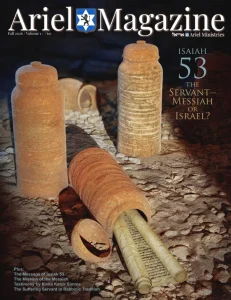
This article originally appeared in Ariel Magazine, Fall 2026, Vol. 1, No. 60. Readers who wish to view the article in its original magazine format may access the complete issue here.
In this article, Dr. Sigler explains how the grammar, structure, and theology of Isaiah 53 identify the Servant as a righteous individual who suffers in the place of sinners, bearing their guilt so that forgiveness, justification, and salvation may be made possible.
Scholars have sometimes proposed that the book of Isaiah was written by multiple authors. According to this theory, “First Isaiah” includes chapters 1–39 and focuses primarily on judgment, while “Second (or Deutero-) Isaiah” includes chapters 40–66 and emphasizes comfort and restoration. Some go even further and propose a third section, often called “Trito-Isaiah,” covering chapters 56–66 because of its strong eschatological themes.
Such theories, however, are unnecessary.[1] They assume that a single author cannot write in different tones or genres. Yet the same person who writes a grocery list can also write a love letter, and the same individual who writes a letter of complaint can also write a letter of apology. Differences in tone reflect differences in subject matter, not necessarily differences in authorship.
This explains the shift within Isaiah itself. Chapters 1–39 emphasize Israel’s sin and the need for divine judgment. Chapters 40–66 emphasize comfort, restoration, and deliverance. In both sections, the same prophet proclaims the same God: the God who judges sin and the God who forgives it. Within this prophetic message stands one of the most significant passages in all of Scripture: Isaiah 53.
The Grammar of Isaiah 53
Most scholars treat Isaiah 52:13–53:12 as one coherent poem. It begins with “Behold, my servant shall prosper…” (52:13) and concludes with the Servant’s exaltation in 53:12. Within this poem, interpreters commonly identify five stanzas (52:13-15; 53:1-3; 53:4-6; 53:7-9; 53:10-12), but these represent poetic divisions rather than ancient chapter breaks.
Ancient Jewish manuscripts, including the Masoretic Text and the Dead Sea Scrolls, did not contain numbered chapters. Instead, they employed scribal paragraph divisions known as petuhot (open sections) and setumot (closed sections), and these do not introduce a break between Isaiah 52:13 and 53:1 that would separate the poem. Early Greek witnesses such as the Septuagint likewise divided the text according to sense units rather than numbered chapters, and New Testament citations such as Acts 8:32-35 quote the section as a single passage. The familiar chapter division that separates Isaiah 53 from 52:13 derives from the chapter system developed in the early thirteenth century, commonly associated with Cardinal Stephen Langton[2] (ca. 1150 – 9 July 1228) and transmitted through the Latin Vulgate and the Paris Bible. This system was later adopted in printed Hebrew Bibles, which is why modern editions display the same chapter numbering.
Isaiah 52:13–53:12 describes a servant who suffers on behalf of others. The identity of the Servant has been understood in several different ways throughout history. Among the most common interpretations are the following: the Servant as corporate Israel, the Servant as the righteous remnant within Israel, the Servant as a historical prophet such as Isaiah or Jeremiah, the Servant as an exiled or ideal Davidic king, and the Servant as the Messiah.[3]
Historically, the corporate interpretation of the Servant as Israel gained prominence in medieval Jewish exegesis, especially through commentators such as Rashi and Rabbis Joseph and David Kimchi.[4] In modern scholarship, the rise of historical-critical methods further encouraged non-messianic readings of the passage. In some cases, more recent historical developments have also contributed to interpretations that view Israel itself as a suffering servant among the nations. While these perspectives attempt to account for the text, they ultimately fail to do justice to its grammatical and contextual features.
Throughout the poem, the Servant is consistently described with third-person masculine singular forms: “he” and “him.” The verbs describing the Servant likewise remain singular, and many of them emphasize actions done to him. He is described as “pierced” (53:5), “crushed” (53:5), “oppressed” (53:7), and “cut off from the land of the living” (53:8). The Servant is therefore portrayed as a single figure who undergoes suffering.
At the same time, the sins mentioned in the passage belong to others. These appear in the first-person plural: “our griefs” (53:4), “our sorrows” (53:4), “our transgressions” (53:5), and “our iniquities” (53:5), while the confession “all we like sheep have gone astray” further emphasizes the collective guilt (53:6). Represented by Isaiah, those speaking repeatedly acknowledge their own guilt while describing the Servant’s suffering. This grammatical contrast establishes a clear distinction between the Servant and the people. One individual suffers, while the guilt belongs to many others. The Servant bears the penalty for the sins of the people. This grammatical distinction also provides a structured response to the view that the Servant represents Israel.
1. The Servant is consistently portrayed as a singular individual rather than a collective entity.
2. The Servant’s suffering is voluntary and marked by silence, which does not characterize Israel’s historical experience.
3. The Servant is described as innocent, whereas Israel repeatedly suffers for her own sins.
4. The Servant suffers vicariously for others, bringing justification and healing, while Israel does not suffer on behalf of others in this manner.
5. The Servant dies and is subsequently vindicated, whereas Israel as a nation has never ceased to exist.
These features together demonstrate that the Servant cannot be identified with the nation of Israel itself.
“Because of the Transgressions of My People”
One of the clearest examples of the grammatical distinction appears in Isaiah 53:8b. The Hebrew text states:
מִפֶּשַׁע עַמִּי נֶגַע לָמוֹ
Literally, the phrase means: “Because of the transgression of my people, the stroke was to him.” The expression “my people” (ʿammî) in Isaiah consistently refers to Israel. Yet the suffering falls upon the Servant, not upon the people themselves. The grammar therefore places the Servant and the people in two distinct categories. The people commit the transgression, while the Servant receives the stroke. The verse thus portrays a figure who suffers for the sins of Israel rather than Israel suffering for her own sins.
In conclusion, in the unified poem of Isaiah 52:13–53:12, the grammatical pattern remains consistent. The Servant appears as a singular, righteous figure who suffers unjustly, while the speakers confess their collective guilt. This contrast between the singular Servant and the plural sinners forms one of the central literary and theological features of the passage.
These grammatical observations also help explain why the Servant in this passage cannot simply represent the nation of Israel. Earlier in the book, Isaiah does at times refer to Israel as the servant of the Lord (Isa. 41:8-9; 44:1-2). Yet Isaiah 52:13–53:12 describes the Servant as suffering for the sins of the people rather than suffering with them. The Servant is distinguished from “my people” (53:8), bears their iniquities (53:6, 11), and is described as righteous (53:11). The passage therefore portrays a righteous individual who suffers on behalf of a sinful nation. The Servant cannot be identical with the nation whose sins He bears.[5]
For this reason, the passage naturally leads into the theological significance of the Servant’s suffering.
The Theology of the Passage
Beyond its grammatical structure, Isaiah 52:13–53:12 presents a profound theological message concerning salvation. The poem unfolds in four movements that trace the mission of the Servant from rejection to ultimate vindication:
1. Verses 1-3 describe the appearance of the Servant and the rejection He experiences.
2. Verses 4-6 reveal the burden He carries as He bears the sins of others.
3. Verses 7-9 describe His suffering and death.
4. Verses 10-12 describe His ultimate vindication and triumph.
A central theme throughout the passage is substitution. This theme may be further clarified through several key theological concepts. The first is imputation. Imputation refers to the transfer or reckoning of guilt or righteousness from one individual to another.[6] Negatively, Scripture teaches that the sin of Adam is imputed to the human race. Positively, the righteousness of the Messiah is imputed to those who believe. In Isaiah 53, the sins of others are laid upon the Servant, and He bears the penalty those sins deserve.
Closely related to imputation is the doctrine of justification. Justification is the judicial act of God by which He declares the sinner righteous. This declaration is not based on human merit but on the righteousness provided through the Messiah. The penalty of sin is fully satisfied through the Servant’s suffering so that those who believe are declared righteous before God.
The passage also presents the concept of substitutionary sacrifice. The Servant’s death is not merely exemplary but vicarious. He dies in the place of others, bearing the punishment that rightly belongs to them. His suffering accomplishes what no human effort could achieve: reconciliation between God and humanity.
The Servant suffers not for His own sins but for the sins of others. The language of the poem repeatedly emphasizes this point. The Servant bears “our griefs” and carries “our sorrows” (53:4). He is “pierced for our transgressions” and “crushed for our iniquities” (53:5). The punishment that brings peace falls upon Him, while healing comes to those whose sins He bears. Isaiah summarizes the situation plainly: “The LORD has laid on him the iniquity of us all” (53:6).
At the same time, the Servant Himself is described as innocent. He suffers unjustly, having committed no violence and spoken no deceit (53:9). He is even described as “my righteous servant” (53:11). His suffering therefore cannot be explained as the consequence of His own sin. Instead, the passage portrays the Servant as submitting to suffering on behalf of others (53:7).
The apostle Paul develops this idea in detail in Romans 4–5. Using the language of accounting, he explains that righteousness is “credited” or “reckoned” to those who believe. Humanity stands before God with a record filled with debt, but through the work of the Messiah sin is removed and righteousness is credited in its place.
Thus Isaiah 53 anticipates one of the central doctrines of the New Testament: the Servant bears the sins of others so that they may be declared righteous before God. The suffering of the Servant therefore becomes the means by which forgiveness, reconciliation, and salvation are made possible.
The Message of Isaiah
Isaiah repeatedly emphasizes that salvation ultimately comes from God alone. In 1:18, the prophet issues an invitation: “Come now, let us reason together,” says the LORD. “Though your sins are like scarlet, they shall be white as snow.”
Human sin separates people from God. Later Isaiah explains that the problem is not that God is unable to save but that human sin creates the barrier between humanity and God (Isa. 59:1-2). Isaiah 52:13–53:12 reveals how that barrier is removed. The Servant becomes the substitute who bears the penalty for sin. Because of this substitution, forgiveness and reconciliation with God become possible.
The message of the book is therefore consistent from beginning to end. The same prophet who announces judgment also proclaims redemption. The God who confronts sin also provides the means by which sin can be forgiven.
Even the prophet’s name reflects this theme. The name Isaiah means “Yahweh is salvation.” His message throughout the book affirms that salvation ultimately comes not from human effort but from God’s provision.
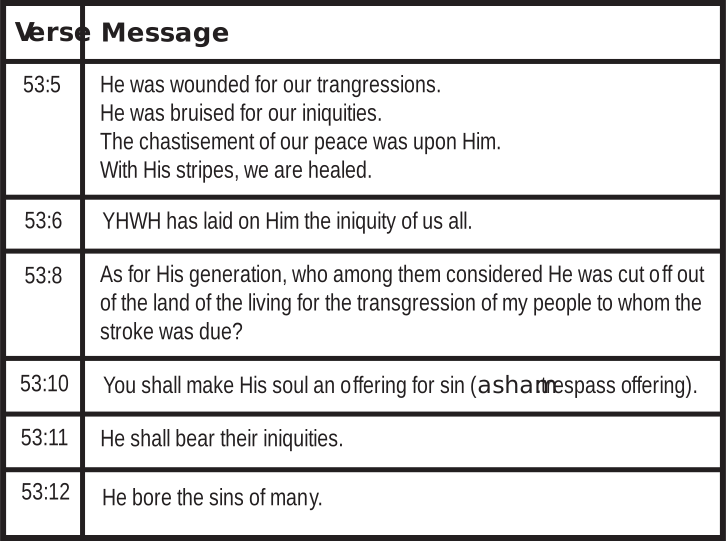
Responding to the Message of Isaiah 53
Isaiah 52:13–53:12 must be read according to its plain sense. When read without presupposition, it speaks of an individual who suffers for the sins of Israel and whose suffering brings justification and salvation. It stands as one of the clearest passages in the Hebrew Scriptures describing a suffering individual who bears the sins of others. The grammar of the text, the structure of the poem, and the theological message of the passage all point in the same direction: the Servant is a single righteous individual who suffers on behalf of the people. However, the message of Isaiah 53 is not merely theological; it calls for a response. The question raised by the prophet in verse 1—”Who has believed our report?”—remains a present challenge to every reader.
The New Testament presents the Servant as the model for those who believe. As 1 Peter 2:21-25 explains, Messiah suffered on behalf of others, leaving an example to follow. Though sinless, He bore the sins of many, demonstrating humility, submission, and trust in God even in suffering.
Believers are therefore called to adopt the same attitude. As Philippians 2:5-7 teaches, they are to reflect the mindset of the Messiah, who humbled Himself and took on the form of a servant.
Have you identified the Servant?
Have you accepted the Servant’s salvation?
Are you following in His steps?
Footnotes
[1]. For an extensive discussion on this topic, see: John N. Oswalt, The Book of Isaiah: Chapters 40–66, NICOT (Grand Rapids, MI: Eerdmans, 1998).
[2]. G. F. Moore, “The Vulgate Chapters and Numbered Verses in the Hebrew Bible,” Journal of Biblical Literature, Vol. 12, No. 1 (1893), pp. 73-78.
[3]. See Andrew H. Bartelt, “The Identity of the Servant of Isaiah 53 in Ancient and Modern Jewish – and Biblical – Interpretation,” Mishkan 43 (2005), pp. 7-8, https://www.caspari.com/wp-content/uploads/2016/06/mishkan43.pdf.
[4]. For a detailed overview of the history of rabbinic interpretation of Isaiah 53, see: Arnold G. Fruchtenbaum, Ariel’s Bible Commentary: The Book of Isaiah (San Antonio, TX: Ariel Ministries, 2021), pp. 741-778.
[5]. For the rabbinic perspective, see: Midrash Rabbah on Ruth 5:6; cf. also Saadia Gaon and early rabbinic interpretations discussed in Fruchtenbaum, Ariel’s Bible Commentary: The Book of Isaiah, pp. 741-778.
[6]. For a more detailed definition of “imputation,” see: Stanley J. Grenz, David Guretzki, Cherith Fee Nordling, Pocket Dictionary of Theological Terms – Over 300 Terms Clearly & Concisely Defined (Downers Grove, IL: InterVarsity Press, 1999), p. 65.
This article originally appeared in Ariel Magazine, Fall 2026, Vol. 1, No. 60. Readers who wish to view the article in its original magazine format may access the complete issue here.
Copyright © 2026 Ariel Ministries. Originally published in Ariel Magazine, Fall 2026, Vol. 1, No. 60. This article is republished on the Ariel Ministries website with permission. All rights reserved. No part of this publication may be reproduced, distributed, or transmitted in any form or by any means without prior written permission from Ariel Ministries. Permission requests may be directed to corporateoffice@ariel.org.
