
By Dr. Arnold G. Fruchtenbaum
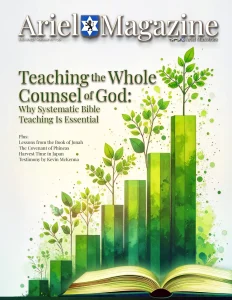
This article originally appeared in Ariel Magazine, Fall 2025, Vol. 1, No. 56. Readers who wish to view the article in its original magazine format may access the complete issue here.
In a time when ministry success is so often gauged by numbers, budgets, or cultural impact, the book of Jonah offers a timely and needed correction. This excerpt from Dr. Arnold Fruchtenbaum’s commentary on the Minor Prophets outlines six key applications drawn from Jonah’s story. Especially relevant to this edition’s cover article is the fifth application, which reminds us that in God’s eyes, it is faithfulness—not visible results—that defines true success in ministry.
Unlike many of the other Minor Prophets, the book of Jonah readily lends itself to theological and personal application. Six key themes emerge.
First, the book teaches the universality of God. YHWH is not only the God of Israel but also the God of all nations—whether they acknowledge Him or not. As Psalm 145:9 declares, “YHWH is good to all; And his tender mercies are over all his works.” While much of the Hebrew Bible focuses on God’s covenant relationship with Israel, Jonah reveals YHWH’s concern for the Gentile city of Nineveh even before it came into direct contact with Israel. This care anticipates the fuller revelation of God’s universal reign, a truth Paul later expands in Romans 9.
Second, the book describes God’s willingness to save Gentiles. Although YHWH’s redemptive work in the Hebrew Bible largely centers on Israel, there are notable exceptions such as Rahab, Ruth, and now the Ninevites. Their inclusion anticipates a major purpose of the present age, namely, to take out from among the Gentiles a people for God’s name (Acts 15:14). Thus, Jonah’s mission illustrates YHWH’s willingness to extend mercy to all who repent, regardless of ethnicity.
Third, the book reveals a pattern found throughout Scripture: the delay of divine judgment to allow time for repentance. Although judgment may be inevitable, it is not always immediate. Just as Nineveh was given forty days, so too was Israel given a grace period between her rejection of the Messiah (Mt. 12) and the destruction of Jerusalem in A.D. 70. God’s patience is purposeful and redemptive.
Fourth, God’s discipline does not mean rejection. The book affirms that YHWH does not cast away those who believe in Him, even when they are disobedient. He disciplines them, but He does not discard them. Jonah was corrected, not abandoned. This principle applies to all believers: God’s faithfulness remains even when ours falters (cf. 2 Tim. 2:13).
Fifth, Jonah’s experience teaches that the results of ministry may at times defy expectations. Sometimes positive results follow reluctant obedience; at other times, faithfulness may seem fruitless. Yet, the outcome is God’s responsibility. As the New Testament shows in 1 Corinthians 3:6, the believer’s task is to sow the seed; God gives the increase. Faithfulness, not manipulation or outcome, is the standard of success.
Sixth, Jonah’s resentment over Nineveh’s deliverance serves as a warning. When we see God blessing other believers in ways we have not experienced, the appropriate response is not jealousy but gratitude for the grace we have received. God deals with each of His children according to His wisdom. Remembering our own undeserved mercy keeps us humble when others are shown grace.
This article originally appeared in Ariel Magazine, Fall 2025, Vol. 1, No. 56. Readers who wish to view the article in its original magazine format may access the complete issue here.
Copyright © 2026 Ariel Ministries. Originally published in Ariel Magazine, Fall 2025, Vol. 1, No. 56. This article is republished on the Ariel Ministries website with permission. All rights reserved. No part of this publication may be reproduced, distributed, or transmitted in any form or by any means without prior written permission from Ariel Ministries. Permission requests may be directed to corporateoffice@ariel.org.
