By Dr. Andy Woods
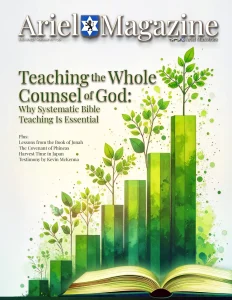
This article originally appeared in Ariel Magazine, Fall 2025, Vol. 1, No. 56. Readers who wish to view the article in its original magazine format may access the complete issue here.
In an era when many churches prioritize topical messages, motivational speaking, or denominational distinctives, there is an urgent need to return to systematic, verse-by-verse teaching of Scripture. This article explores seven key reasons why teaching the Bible itself, rather than merely teaching from or about it, is essential for the health of both the church and its teachers.
Any college or seminary that seeks to honor God will strive to develop individuals who teach the Bible—not merely from it or about it, but the Bible itself. A good Bible teacher systematically moves through Scripture book by book, chapter by chapter, verse by verse. This systematic approach does not diminish the value of topical studies when necessary. However, the primary diet of the church should be a structured journey through Scripture, addressing subjects and topics in the order that the Holy Spirit has placed them. In my personal opinion, the church has been preached to death. The greatest need is for Bible teachers who faithfully instruct believers in God’s Word. A systematic approach to teaching Scripture provides several essential benefits.
1. Encourages Personal Bible Reading
The first reason to teach Scripture systematically is that it promotes personal Bible reading. A verse-by-verse approach naturally fosters engagement and anticipation. When people know the direction of the teaching, they are more likely to read ahead. For example, if a sermon series is covering Matthew 24 and the congregation is informed that the next week’s message will focus on Matthew 25, a specific reading focus is provided. Rather than receiving a general encouragement to read the Bible, believers have a clear directive, making consistent Scripture reading more likely.
2. Defends Against “Sermon Aiming”
The second reason for teaching the Bible systematically is that it serves as one of the best defenses against “sermon aiming”—the tendency to tailor messages toward specific individuals or behaviors.
A common scenario is that a pastor sees someone engaging in a certain behavior during the week—let’s say they have been gossiping—and he decides to address this behavior from the pulpit next Sunday. So, he prepares a sermon on James 3 about taming the tongue, fully intending to “stick it to them.”
But here is the problem: It never works. I admit that I have tried it, and every time it has backfired. The person I was aiming at either did not show up that particular Sunday, was distracted on their mobile phone, or arrived late. Through this, the Holy Spirit has convicted me, asking whether I was going to preach His sermon or mine. In the end, God is the one who convicts through His Word—not us.
Since biblical truth naturally impacts people at a personal level, anyone in teaching ministry will, at some point, be accused of sermon aiming. Someone might say, “Pastor, you preached that because you knew about my situation!” Yet, the reality is that the pastor who systematically moves through the Word may have had no idea about their circumstance. It was simply the Holy Spirit at work through Scripture. If someone feels convicted, their issue is not with the pastor—it’s with the Lord and His Word.
So, beyond the clear spiritual benefits, there are also practical reasons why pastors should commit to systematically moving through the Bible.
3. Prevents Fixating on Personal or Denominational “Hobby Topics”
The third reason for adopting a more systematic approach to Bible teaching is that it prevents falling into the trap of a proverbial “hobby horse.” Bible teachers and preachers tend to gravitate toward subjects that interest them the most. A well-rounded, systematic approach to theology serves as a safeguard against this tendency.
Every preacher and denomination has favorite topics. Some churches focus almost exclusively on signs and wonders, while others emphasize the sovereignty of God. In evangelistic circles, sermons often consist primarily of presenting the gospel—sometimes inaccurately—leading people to feel the need for repeated salvation experiences even after having been believers for years. If salvation could be lost and regained weekly, as some mistakenly suggest, this might make sense—but of course it cannot. If, for example, a teacher or preacher loves end-times eschatology, or the importance of a literal understanding of early Genesis, or apologetics, every single sermon ever preached might deal with these specific subjects.
The pressure to emphasize denominational distinctives is ever present in the church world. These themes inevitably find their way into sermons, regardless of whether they align with the passage being taught. Likewise, personal interests can easily shape the focus of preaching, diverting attention from the actual message of the text.
A systematic approach prevents this imbalance. The weight of a topic is assigned based on the emphasis given in Scripture, ensuring that no single theme is disproportionately emphasized to the detriment of others. This holistic method naturally curbs the tendency to push personal or denominational distinctives beyond the priority given to them in the biblical text.
4. Compels Engagement with Uncomfortable Topics
The fourth reason for adopting a systematic approach is that it forces engagement with biblical subjects and topics that might otherwise be avoided.
Certain passages contain difficult or uncomfortable truths that might never be chosen as sermon topics under a more selective approach. For example, Genesis 19 recounts the incestuous relationship between Lot and his daughters. Left to personal preference, few would voluntarily select such a passage for teaching. However, when systematically moving through Scripture, there is no choice but to address what is there in the chapter.
The same is true for passages like Matthew 5:31-32 or Matthew 19:7-9, which deal with divorce and remarriage. In a congregation where many have experienced divorce, these topics can feel difficult to address. Yet, systematic teaching ensures that the whole counsel of God is faithfully proclaimed, rather than avoiding passages that may be challenging. Those listening understand that nothing is being singled out or skipped over—it is simply the next passage in the text.
This discipline is essential for spiritual growth. Scripture contains teachings that challenge, convict, and stretch believers, much like a well-balanced diet is necessary for physical health. Just as a child may resist eating vegetables but needs them for proper nourishment, believers need the full spectrum of biblical truth—even the parts that may be difficult to digest.
This lack of balanced teaching explains why so many Christians today are spiritually undernourished. A steady diet of self-help messages, motivational speaking, or selective
biblical themes may make believers feel happy, but it does not produce strong, mature Christians capable of standing firm in spiritual warfare.
A systematic approach ensures theological balance. Many biblical truths exist in tension, such as the question of God’s sovereignty versus human free will. Depending on personal preference, there is always a temptation to focus on passages that align with a particular theological leaning. However, both are true and both must be taught. The same principle applies to the believer’s wealth in Messiah versus the believer’s walk in obedience. Ephesians 1–3 emphasizes the believer’s position and blessings, while Ephesians 4–6 calls for practical application. If only the latter is taught without the former, believers are sent into battle without the proper foundation.
This concept is what Paul refers to as “the whole counsel of God” (Acts 20:26-27). Faithful teaching requires declaring all that God has revealed, rather than selectively emphasizing certain aspects while neglecting others. Yeshua Himself demonstrated this when resisting Satan’s temptations in Matthew 4:4, quoting Deuteronomy 8:3: “Man shall not live by bread alone, but by every word that proceeds from the mouth of God.” Every word of Scripture is inspired, and all of it is profitable (2 Tim. 3:16-17). Thus, believers cannot be fully equipped without accessing and applying the totality of God’s Word.
A teaching ministry must, therefore, commit to proclaiming all of Scripture, and the most effective way to do this is through systematic, verse-by-verse exposition.
5. Preserves Biblical Context and Mitigates Heretical Teaching
The fifth reason for training and encouraging pastor-teachers in a systematic approach is that it preserves biblical context.
It is all too easy to lose context and manipulate Scripture to say whatever one desires. Consider the following example: “Judas went out and hanged himself.” “Go and do likewise.” “What you do, do quickly.” Each of these phrases is taken directly from the Bible, yet when strung together, they create an absurd and false conclusion—one that completely misrepresents the truth.
This illustrates a key reality: all heresy is biblical. Every false teacher quotes Scripture. This is evident in so-called Christian television, where prosperity gospel preachers insist that believers are entitled to health, wealth, and prosperity because they are supposedly “little gods.” Figures like Kenneth Copeland and others frequently cite Scripture, often even more extensively than some in evangelical churches.
The problem is not the use of Scripture but its misuse—ripping verses out of context to support preexisting false doctrines. What is difficult to find, however, is a heretic who teaches the whole Bible. As soon as someone commits to working through entire books of the Bible, the amount of heresy decreases dramatically.
Why? Because systematic teaching forces engagement with the full counsel of God. When moving verse by verse through Scripture, ignored passages can no longer be avoided. A more complete picture of biblical truth emerges, making it far more difficult to sustain false doctrines.
Every written text—including Scripture—has a context. If a letter or email is received, it would be absurd to isolate the first sentence, a random phrase from the middle, and the final line to create a fabricated meaning. Yet this is exactly how many mis-handle the Bible.
The three rules of real estate are location, location, location. The three rules of biblical interpretation are context, context, context. Without a systematic approach to teaching Scripture, context cannot be properly developed, leading to distortion and misunderstanding.
It is also important to acknowledge that this method may not fill auditoriums—in fact, it may have the opposite effect. A commitment to systematic teaching requires a clear philosophy of ministry that prioritizes truth over popularity. There are sound, biblical reasons for systematically presenting God’s Word, and these must be kept in mind even when the results do not align with modern expectations of church growth.
6. Brings Believers into Spiritual Maturity
The sixth reason for prioritizing systematic, verse-by-verse teaching—teaching not merely about the Bible but the Bible itself—is that it moves believers out of an arrested state of spiritual development.
Many believers remain spiritually stagnant, often without realizing it. They are saved, regenerated, and born again, yet their growth is stunted. This condition persists as long as they are in environments where Scripture is presented selectively rather than systematically.
Far too often, churches repeatedly recycle basic gospel presentations, leaving congregants in a perpetual state of spiritual infancy. While every sermon should include the gospel—since there is no certainty about who in the audience is saved—the Bible calls believers to progress beyond the basics (Heb. 6:1). The most effective way to facilitate this growth is by exposing them to the totality of God’s Word.
Job 23:12b declares: “I have treasured the words of His mouth more than my necessary food.” Spiritual maturity is nurtured by the intake of truth. This explains why Jesus said in John 17:17, “Sanctify them by the truth, your word is truth.” Similarly, 1 Peter 2:2 instructs believers to “long for the pure milk of the word, so that by it you may grow in respect to salvation.” Notice the emphasis on purity. A newborn cries out for nourishment, yet if its milk is diluted with anything foreign—whether water or soda—it cannot develop properly. The same principle applies to spiritual nourishment.
In the medical field, there is a clear distinction between an obstetrician and a pediatrician. An obstetrician assists in childbirth, while a pediatrician oversees a child’s development. These are separate, specialized roles. Similarly, in the church, evangelists function as spiritual obstetricians, guiding people to salvation. Pastors and teachers function as spiritual pediatricians, ensuring growth and maturity.
Unfortunately, many churches fail in this second role. The result? Congregations are then filled with spiritual infants. Paul rebukes the Corinthians for this very issue in 1 Corinthians 3:1-3: “And I, brethren, could not speak to you as to spiritual men, but as to men of flesh, as to infants in Messiah. I gave you milk to drink, not solid food; for you were not yet able to receive it. Indeed, even now you are not yet able, for you are still fleshly. For since there is jealousy and strife among you, are you not fleshly, and are you not walking like mere men?”
Infants sucking their thumbs are adorable at six months old. At sixteen years of age, it becomes a sign of arrested development. This is the condition of many in the church today. Decades pass, yet these believers remain spiritually immature, trapped in jealousy, strife, and fleshly behavior indistinguishable from the unsaved world. In fact, an out-of-fellowship believer can out-sin an unbeliever on any given day.
Church signs often boast: “We are a first-century church.” The real question is: Which first-century church? Corinth? Laodicea? Many pastors today spend their ministries patching up petty disputes—disputes that would not exist if the congregation had been properly grounded in Scripture and spiritually matured.
Spiritual infancy persists not because believers lack the ability to grow but because many pastors fail to equip them. Either through insufficient training or misguided priorities, the responsibility for a congregation in an arrested state of spiritual development ultimately falls on the pastor-teacher.
A pastor who fails to prioritize the systematic teaching of Scripture condemns his congregation to spiritual stagnation. Without a commitment to verse-by-verse exposition, believers remain trapped in immaturity—unable to endure trials, stand firm in faith, or live out the fullness of their calling.
7. Delivers the Pastor-Teacher
The seventh and final reason for prioritizing systematic, verse-by-verse teaching—primarily from the pulpit, though other platforms also exist—is that it delivers the teacher.
Dr. Pentecost of Dallas Seminary once observed: “Men, you will pack out the church when you teach the Book of Revelation. But you will empty it when you teach the Book of Romans.” This statement holds true—certain biblical topics naturally draw interest, while others require spiritual endurance to grasp.
J. Vernon McGee advised young pastors to begin their ministries by teaching Romans, not necessarily because it would immediately transform their congregations but because it would transform them. This wisdom proved true in personal experience: Teaching Romans verse by verse for the first time led to more personal spiritual growth in a single year than in previous years combined. Whether or not it profoundly impacted those listening, the discipline of working systematically through Scripture brought immense spiritual benefit.
Ezekiel 3:17-19 records God’s charge to the prophet: “Son of man, I have appointed you a watchman to the house of Israel; whenever you hear a word from My mouth, warn them from Me. When I say to the wicked, ‘You will surely die,’ and you do not warn him… that wicked man shall die in his iniquity, but his blood I will require at your hand. Yet if you have warned the wicked and he does not turn… he shall die in his iniquity; but you have delivered yourself.”
The same commission is repeated in Ezekiel 33:7-9, reinforcing the principle that the watchman is accountable not only for what he says but also for what he fails to say. If truth is withheld, responsibility remains. However, if the message is faithfully delivered, the burden is lifted.
This responsibility extends beyond the Old Testament. Paul echoes Ezekiel’s language in Acts 20:26-27: “Therefore, I testify to you this day that I am innocent of the blood of all men. For I did not shrink from declaring to you the whole purpose of God.”
Paul clearly understood that teaching the full counsel of God was essential to his ministry, ensuring that no necessary truth was omitted. James 3:1 further reinforces this accountability: “Let not many of you become teachers, my brethren, knowing that as such we shall incur a stricter judgment.”
Heresy is spread not only by what is taught incorrectly but also by what is left unsaid. Many churches provide solid biblical teaching, yet entire doctrines are omitted. Conversations often reveal this reality:
“I have attended this church for years, but I have never heard a sermon on Israel.”
“I have never heard a message on biblical creation.”
“I have never been taught about dispensations.”
These omissions are not accidental—they reflect a selective approach to Scripture that neglects portions of God’s Word. This is precisely what Ezekiel 3 and Ezekiel 33 warn against.
Systematic teaching removes this burden. There is no fear of omission when every passage is addressed in its proper time. The responsibility shifts entirely to those who hear, as their response to the truth is between them and God.
If accountability is required at the Judgment Seat of Messiah, there is a simple defense: “Lord, I taught through the whole Word. Every passage was addressed. The record is there.”
Teaching verse by verse, chapter by chapter, and book by book ensures that no doctrine is ignored, no difficult passage is avoided, and no responsibility is neglected. In this way, systematic teaching not only equips the congregation but also delivers the teacher from accountability for failing to declare the full counsel of God.
Conclusion
We seek to train individuals with a comprehensive understanding of the full counsel of God’s Word, equipping them to be effective in ministry according to His design. The seven reasons to teach the Bible—and not just from or about the Bible—are:
It stimulates Bible reading.
It serves as a defense against sermon aiming.
It prevents fixating on personal or denominational “hobbyhorses.”
It compels engagement with difficult or uncomfortable topics.
It preserves biblical context and mitigates heretical teaching.
It brings believers into spiritual maturity.
It delivers the teacher.
May the Lord see fit to graciously give us a new generation of equipped and prepared pastor-teachers who see as their priority to teach systematically and verse by verse the whole counsel of God’s Word!
This article originally appeared in Ariel Magazine, Fall 2025, Vol. 1, No. 56. Readers who wish to view the article in its original magazine format may access the complete issue here.
Copyright © 2026 Ariel Ministries. Originally published in Ariel Magazine, Fall 2025, Vol. 1, No. 56. This article is republished on the Ariel Ministries website with permission. All rights reserved. No part of this publication may be reproduced, distributed, or transmitted in any form or by any means without prior written permission from Ariel Ministries. Permission requests may be directed to corporateoffice@ariel.org.