
By Rivka Katzir Simms
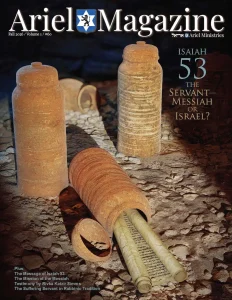
This article originally appeared in Ariel Magazine, Fall 2026, Vol. 1, No. 60. Readers who wish to view the article in its original magazine format may access the complete issue here.
I was born to my parents in their old age as the fourth child, much younger than my three older siblings. My father came to Israel from Poland in 1927, and my mother was born in Jerusalem in 1925.
Questions about the Existence of God
I was raised in Kibbutz Alonim in the Jezreel Valley. My kibbutz was very secular, as are most kibbutzim. In our community, anyone who believed in God was regarded as quite strange. If someone did believe in God, he would likely have kept it secret for fear of being ostracized.
Ironically, however, because we were Jews, we were required to study the Bible from the second grade through the twelfth grade. Whenever we read about the miracles recorded in Scripture, my teacher would explain that there is no God and that these miracles could either be explained by natural causes or dismissed as the product of human imagination.
At the same time, there is a very widespread custom in Israel, even among secular Jews, never to pronounce the most holy name of God. The divine name יהוה (YHWH) is written in the text, but it is read aloud as “Adonai.”
As I grew older and began developing my own thinking, I started asking questions about the existence of God. It troubled me that I had no conclusive answer that could either prove or disprove His existence. One day, while I was in the eighth grade, I was standing outside my classroom and thought to myself,
“Let me test God by pronouncing His most holy name. If I observe something in nature, such as the rustling of leaves or a sudden gust of wind, I will know that it bothers God that I have spoken His name, and I will know that He exists.”
Quietly, I spoke the holy name and waited for something to happen in nature. Nothing occurred. I said it again, a little louder. Still nothing. The third time I said it louder and repeated it several times. Yet nothing unusual happened in nature. Everything remained exactly as before. I was even willing to accept something very small as a sign, but there was none. Based on that test, I concluded that there was no God.
After a few months, however, I realized that this had not been a very good test for determining whether God exists. After considering what my next “test” should be, I decided to give God an opportunity to speak to my heart. I said to Him,
“I do not believe that you exist, but if by chance you do, please reveal yourself to me. I will give you an opportunity by reading the Tanach, the Hebrew Bible, from cover to cover.”
I began with Genesis, and about a year later I reached the end of 2 Chronicles, the final book in the Hebrew Bible. When I closed the book, I intellectually concluded that God does indeed exist. To me, the account of creation was more reasonable than the theory of evolution.
Another convincing argument was the history of the Jewish people. God took for Himself a people through Abraham and promised him a land, numerous descendants, and many blessings. Now, some four thousand years after that promise, we possess our own land, despite repeated attempts throughout history to destroy us. These attempts began with Pharaoh and continued through the Babylonians, Haman, the Greeks, the Romans, the Inquisition, various Arab powers, and the Holocaust. In every generation, there have been those who sought our annihilation, yet we remain and now have an independent state. For this to be the case, I reasoned, there must be a God who watches over Israel. In this way, a small seed of faith began to grow in my heart—a belief in the existence of God.
Keeping the Budding Faith Secret
Of course, I did not share my new belief with anyone. Who in their right mind would want to be made fun of or shunned? After a few months, however, I began to ask myself whether something in my life should change in light of this belief. It seemed that something was still lacking. Since I am Jewish, I decided to explore Judaism more seriously.
To do so, I used my Passover vacation to take the bus to a religious center in Tzfat but told my mother that I was visiting another girl in a different kibbutz. Located in the Galilee, Tzfat is a very religious city and home to a Chabad yeshiva for people who are seeking to return to Judaism. I was there for the entire two-week school break. Yet, instead of finding anything that would have completed my faith in God, I encountered a lot of dos and don’ts that did not appeal to a sixteen-year-old who grew up in a secular and very liberal kibbutz.
Meeting Leo
All teenagers in the kibbutzim have to work one day a week somewhere within the community. My assigned work was in a factory that specialized in anodizing aluminum. One of the volunteers working there was an American named Leo, who stood out markedly from everyone else. He had lost his leg in a motorcycle accident and used a peg leg rather than a prosthesis. He would fold his pant leg up to the knee, making the peg leg clearly visible. Because the peg was so unusual, it attracted my attention. Hence, I also noticed his behavior. He was the best worker. He never complained and was very cheerful and kind to everyone, especially to the elderly folks. He would go around the kibbutz doing good deeds for people who needed things to be done, like weeding their front yard or making stands for people’s sculptures, including some for my mother.
Intellectual Faith vs. Heart Knowledge
One day I asked him why he was so different from everyone else. He replied that it was because he believed in God. Quietly, I told him that we had something in common since I also believed in God.
“Your faith is an intellectual faith, in your mind,” he said. “My faith is in my heart.”
Thinking back to the Orthodox Jews I had encountered in Tzfat, I responded, “I know some very serious religious people who sincerely believe in God with all their heart, but they are not different like you. What is it about you that makes you so different?”
His answer surprised me: “I believe in the Jewish Messiah.”
“I wish He had already come,” I said, “because then there would be no wars.”
He then told me that his Jewish Messiah is Yeshua. I had never heard the name before, so I asked if he meant “Yeshu,” a term used by unbelieving Jews as a reference to Jesus. This name, commonly used in Israel, is actually an acronym meaning “May his name and memory be blotted out.” When I realized that he was indeed speaking about Jesus, I thought that nothing could be further from the truth. How could Leo, such an intelligent man, believe something so unreasonable: that the Almighty God, the Creator of the universe, would humble Himself to become a human being? And how could someone like Leo, who was kind and generous to everyone, believe in a figure in whose name so many Jews had suffered and died? It made no sense to me. I even felt sorry for Leo and, out of genuine concern, wanted to show him that he was mistaken. I wanted to prove him wrong—not for my sake but for his.
Lively Discussions
Leo and I spoke and argued about his faith many times. I made it my goal to help him recognize what I believed to be his error. Yet every time we discussed these matters, he prevailed in the conversation, and I found myself without an adequate response. He was a well-studied student of the Bible, whereas I knew very little about faith, religion, or spiritual matters. My knowledge was minimal in comparison to his.
After months of these arguments, I said to myself,
“I am wasting my time trying to prove him wrong. He is not going to stop believing this, and he says that his faith gives him peace, joy, and a sense of purpose…”
Those were precisely the things I longed to have in my own life. Yet what did I have to offer him in return in terms of faith? Nothing. My life felt empty, lacking true meaning and certainly lacking genuine faith.
At the same time, I reasoned that since he was a Gentile, perhaps it was acceptable for him to believe incorrectly. But we, the Jewish people, must hold to the truth. On that basis, I decided to abandon my efforts to persuade him to give up his belief in Yeshua.
School Assignment about the Identity of the Suffering Servant
About two years later, I was finishing my last year of high school. Most seniors devote themselves to preparing for the Israeli matriculation exams, which determine whether they can pursue an academic path after military service. In the year I graduated—1980—we were also required to write a paper for Bible class as part of the matriculation process. That year, and only that year, the assigned topic was “Who is the suffering servant of Isaiah 53?”
Naturally, I turned to Leo for help since he was far more knowledgeable in biblical matters. He explained that there are two primary interpretations. According to the common Jewish view, the suffering servant represents Israel, suffering on account of the sins of the Gentiles. In this sense, Israel becomes like a scapegoat for the nations. For example, Nebuchadnezzar of Babylon took Israel into captivity, and the Jewish people suffered under his cruel rule. Likewise, during the Holocaust, the Jews went like a lamb to the slaughter without protest.
Leo, however, supported the interpretation held by most Christians—namely, that the suffering servant is the Messiah. According to this view, the servant is a Jew who comes from Isaiah’s own people and who dies as a sacrifice for the sins of others.
Wanting to be different and original, I chose to write my paper in support of Leo’s interpretation of Isaiah 53. When my teacher read it, she asked where I had learned this view. I told her about the volunteer who had helped me. She replied, “If he believes that, he must be a Christian. Let me explain what Christians are about. They want to convert you to their religion; they ‘win souls’ for Christianity. In fact, they believe that every person they convert earns them ‘points’ and a better place in heaven.” She went on to say that missionaries are the worst of all. According to her, they go to developing countries, provide food, clothing, and medical care, and in return persuade people to give up their souls for Christianity. Her words unsettled me.
Before leaving, she added, “Be careful. That volunteer might be a secret missionary.” I thanked her and went home, determined to have one final conversation with Leo. I intended to confront him, convinced that he had been trying to convert me so that he could gain “points” in heaven.
“If you can show me Yeshua in my Bible, I will believe.”
At the end of my angry conversation with Leo, I said goodbye and asked that we no longer speak, lest he find another way to persuade me to believe in Yeshua. I even pointed out that, no matter what we talked about, our conversations somehow always turned to spiritual matters. So, as a precaution, I said, “Let’s not talk at all about anything. Goodbye.”
“May I say two final things?” he asked. I agreed.
He continued, “I want you to remember that every time we spoke about spiritual matters, you were the one who led the conversation in that direction.”
“All right,” I said. “What is the second thing you wanted to say?”
“I take my faith from your Bible,” he replied.
“Wait a minute,” I responded.
“I have already read the Bible, and I did not see any mention of Jesus or Yeshua. If what you are saying is true, why do not all Jews believe it? All right, Leo—if you can show me Yeshua in my Bible, I will believe.”
Studying the Messianic Prophecies
In response to my challenging words, Leo invited me to come to his apartment every Monday evening at 8:00 p.m. to study Messianic prophecies and their fulfillment in the New Testament. At that point, God’s sense of humor was not lost on me. I had gone to tell Leo that we should no longer speak at all, yet we ended up setting a regular time to meet and discuss Messianic prophecy.
Three of us gathered in Leo’s small apartment to study Messianic prophecies: Leo, me, and a man from Russia named Eliyahu, who was also interested in Leo’s faith. We examined a number of passages, though most of them went over my head. However, three in particular made a deep impression on me.
“Behold, the days are coming, declares the Lord, when I will make a new covenant with the house of Israel and the house of Judah” (Jer. 31:31). In Hebrew, the phrase “new covenant” uses the same words that are later applied to what is called the New Testament. I found it striking that the concept of a “New Testament” was already present in my own Bible.
“And after the sixty-two weeks, an anointed one shall be cut off and shall have nothing. And the people of the prince who is to come shall destroy the city and the sanctuary. Its end shall come with a flood, and to the end there shall be war. Desolations are decreed” (Dan. 9:26). From this passage, I came to understand that the Messiah would have to die before the destruction of the Second Temple. In Jewish history, there have been several individuals who claimed to be the Messiah, but all of them—except Yeshua—appeared after the destruction of the Temple in A.D. 70.
The third passage was Isaiah 53. This time, we studied the chapter not merely as an academic exercise but with genuine interest. As I examined the Hebrew grammar more carefully, it became clear to me that the passage could not be referring to the Jewish people suffering for the sins of the Gentiles. Rather, it pointed to a single individual—a man from Isaiah’s own people—who would suffer and die for the sins of both Jews and Gentiles. When we finished studying Isaiah 53, I told Leo that the passage was very persuasive and that I was concerned it might lead me to believe in Yeshua. Since I was Jewish and Jews did not believe in Yeshua—or so I thought—I concluded that we should end our Bible study, and so we did.
Strawberry Shortcake
A few weeks later, Leo’s parents came to visit him in Alonim, my kibbutz. Everyone there knew that his parents were missionaries in Africa. Because of what I had been told about missionaries, I initially gave them a cold reception. At the same time, I was curious to meet them since they had such a remarkable son. So I decided to visit them one day.
When I entered the apartment, I met Leo’s mother, Gloria. She was warm, cheerful, and genuinely kind. Almost immediately, my preconceived ideas about missionaries began to dissolve. I found myself thinking, “These people are so kind. They cannot be what I imagined.”
When Gloria asked whether I would like her to teach me how to make vanilla rice pudding or strawberry shortcake, I just fell in love with her. Growing up in the kibbutz, we had little opportunity to cook or bake, and I had always wanted to learn. From that point on, I began visiting Leo’s apartment as often as I could.
One day, Gloria was sitting alone, typing a letter that Leo had written to a woman named Debra. Earlier, Gloria had asked Leo whether he had seen any fruit from his labor for the Lord. Leo told her about a Jewish American woman who studied Hebrew with him in the ulpan and had shown interest in his faith. When she returned to Boston, she asked him two questions, to which he had responded with a seventeen-page letter.
The questions were these: If a person believes in God, why is a mediator necessary? Why can one not go directly to God? And if a Jew seeks to keep the Mosaic Law as faithfully as possible, why would that not be sufficient for salvation?
Gloria appreciated Leo’s answers and was making a typed copy for herself. When I arrived and saw what she was doing, my curiosity was immediately aroused. When she told me she was typing a letter that Leo had written to Debra, my antennas went up and I thought I would get some juicy gossip about Leo and Debra, so I asked her to read the letter to me. Leo had previously warned Gloria that Israel was not like Africa and that she should not speak about Yeshua unless someone asked her directly. In this case, I was the one asking.
Gloria was delighted to read it to me, though she had no idea what would come of it. It took us three days to work through the entire letter in English. Much of it went over my head since it was philosophical in nature and written in elevated language, and at that time my English was limited. Yet two points stood out clearly to me.
Jesus the Jew, the Passover Lamb
First, I came to understand that Jesus was a Jew and that He came first to the Jewish people. The message of the Gospels is rooted in my own Tanach, and all the writers of the New Testament were Jewish as well. This realization helped me overcome the barrier I had always assumed—that, as a Jew, I could not believe in Yeshua.
Second, Leo drew an analogy between the Passover lamb and Yeshua. Just as the blood of the lamb placed on the doorposts in Egypt protected the firstborn from God’s judgment, so the blood of Yeshua, applied by faith, covers the heart and protects from divine judgment.
When I grasped this point, I said,
“Just think, Gloria—if you had not come to Israel, I might never have believed in Yeshua.”
As soon as I said it, I was startled by my own words and thought to myself that I should not have said that.
Gloria responded with great wisdom,
“It is not enough simply to believe in Jesus. Even the devil believes in Him. What matters is receiving Him as your personal Savior and the One who forgives your sins.”
Then, with evident joy, she added,
“Wouldn’t it be wonderful if you were born again today—on your eighteenth birthday?”
The Astounding Concept of Being Born Again
I did not understand the term “born again,” and I did not ask her to explain it. I was concerned that doing so might put her in an uncomfortable position or that she might not be able to explain it clearly. Instead, I went out to the woods, which was the only place where I could be alone. There, surrounded by large oak trees (in Hebrew, alonim), I wrestled with God in prayer, asking Him to deliver me from my confusion and to help me know what decision to make regarding faith.
When the struggle came to an end, I found myself in a position similar to Jacob, who wrestled with the Angel at Peniel and would not let go until he received a blessing. In that moment, I surrendered my life to the One I had been seeking—to Yeshua. It was May 17, 1980 (one day before the eruption of Mount St. Helens). There, in the woods, I said to God, “I am yours completely.” I chose to accept Yeshua as my personal Savior and the One who forgives my sins.
Much has taken place since then. Looking back, had I known how difficult life would become once others learned of my faith, I might have hesitated to take that step in May of 1980. Yet I am grateful that I did not know what lay ahead. In every difficulty, God was present with me, strengthening my faith and sustaining me through each stage of the journey.
The account of what followed after I began this walk with Yeshua belongs to another chapter.
This article originally appeared in Ariel Magazine, Fall 2026, Vol. 1, No. 60. Readers who wish to view the article in its original magazine format may access the complete issue here.
Copyright © 2026 Ariel Ministries. Originally published in Ariel Magazine, Fall 2026, Vol. 1, No. 60. This article is republished on the Ariel Ministries website with permission. All rights reserved. No part of this publication may be reproduced, distributed, or transmitted in any form or by any means without prior written permission from Ariel Ministries. Permission requests may be directed to corporateoffice@ariel.org.
